
We were recently instructed to carry out a PiCUS sonic tomography test on a mature Oak tree in a public-use setting, where concerns had been raised about possible internal decay at the base of the stem.
Why Visual Inspection Isn’t Always Enough
Mature trees can appear perfectly healthy from the outside while significant structural changes are occurring internally. Thick bark, old cavities, and historic pruning can mask decay that is not immediately obvious through visual inspection alone.
Traditional methods such as sounding with a hammer can provide useful clues, but they have limitations, particularly on large, thick-barked species such as Oak.
What Is a PiCUS Test?
PiCUS sonic tomography is a non-invasive diagnostic method that measures the speed of sound waves travelling through the stem. Sensors are placed around the circumference of the tree, and the data collected is used to generate a two-dimensional image of internal wood condition at a specific height.
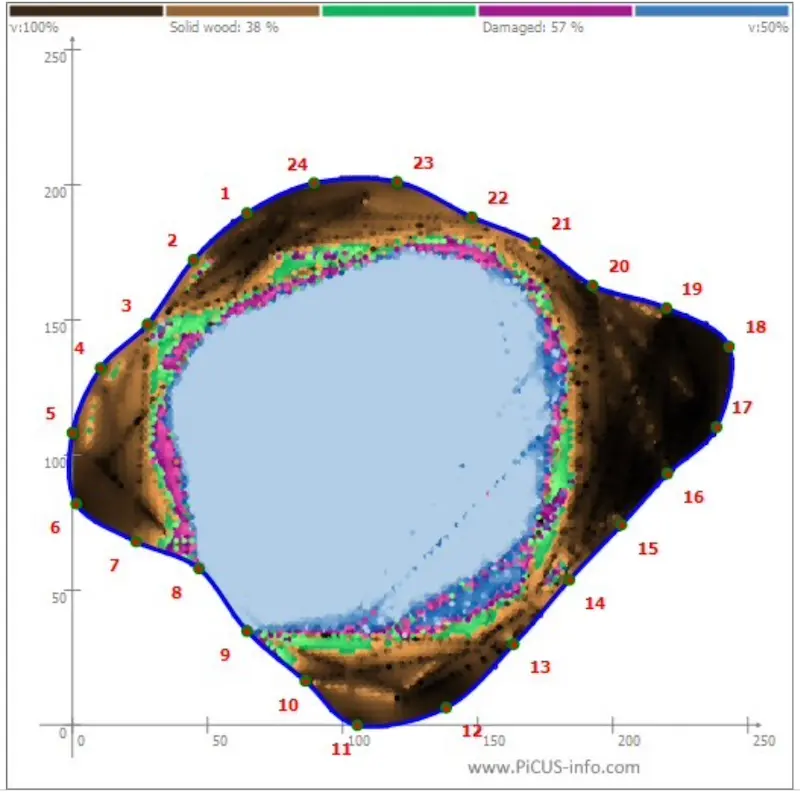
The scan in this case revealed a significant area of internal decay at the tested level, highlighting the value of objective testing when structural integrity is in question.
Putting Decay Into Context
It is important to understand that a PiCUS scan represents a single cross-section of the tree. A high percentage of damaged wood at one level does not automatically mean failure is imminent.
Species such as Oak are capable of tolerating substantial internal hollowing for extended periods, depending on stem diameter, residual wall thickness, crown loading, and site conditions. Interpreting results correctly is therefore essential.
Understanding the Tomograph Results
The tomograph image displays variations in wood density using colour coding. Areas shown in darker and cooler tones represent significantly degraded or hollow wood, while warmer tones indicate denser, structurally sound timber. In this instance, the scan identified a substantial central area of decay at the tested height, with a surrounding band of residual structural wall.
When interpreting this type of result, the key consideration is not simply the percentage of damaged wood, but the thickness and continuity of the remaining load-bearing wall. Structural stability depends on how that residual wall distributes mechanical stress, particularly under wind loading
Evidence-Based Tree Management
In areas of public access or where trees stand close to property, data-led decision-making is crucial. PiCUS testing allows arborists to move beyond assumptions and make proportionate management recommendations.
As part of our tree surgery services, we undertake advanced diagnostic assessments where required, helping retain mature trees wherever safely possible.
If you have concerns about a large or historic tree, you can contact us to discuss inspection options.